In Lewis Carroll's Alice's Adventures in Wonderland, the Caucus Race is proposed by the eccentric Dodo to dry off the characters after they emerge from the Pool of Tears. The race, chaotic and without rules, ends with a decree from the Dodo in the same spirit: "everybody has won, and all must have prizes."
That iconic passage lends its name to a phenomenon in psychology: the "Dodo Bird Verdict." The concept captures the finding that different therapeutic approaches, despite their differences, tend to produce similar outcomes (Cordioli & Grevet, 2018). The most accepted explanation is that results don't come from specific techniques, but from common factors — elements like therapeutic alliance, empathy, and expectation of improvement. Put another way: perhaps clinical psychology spent too long arguing over who wins the race, when the real problem was the rules of the game. That's exactly where the need for frameworks that "translate" concepts across different approaches becomes clear.
In our work at the Institute, we get to interact as professionals from different fields studying common topics. One of the most fascinating things we've noticed over the years is how often we're referring to similar things using different terms, or starting from different organizing theories — and how, sometimes, borrowing a repertoire from an unfamiliar field fits a practical challenge better than staying locked into a single perspective. We act as interpreters between fields of knowledge, a role in which a dictionary is extremely useful.
The Behaviour Change Intervention Ontology (BCIO), proposed by the research group at University College London's (UCL) Centre for Behaviour Change (CBC), translates that effort into the field of behavioral science. The undertaking standardizes concepts across the field, ensuring practitioners and academics speak the same language, and enabling the science to advance. Last Thursday, the Brazilian Institute of Behavioral Sciences held an internal briefing for its members on proposed updates and expansions to the BCIO and its seminal model, COM-B (Michie et al., 2011).
Among the main updates is an expansion of Behaviour Change Techniques (BCTs) — the "atoms" of interventions — from around 93 to more than 200. This shift isn't just quantitative; it reflects an effort to bring the different sciences that make up the field closer together.
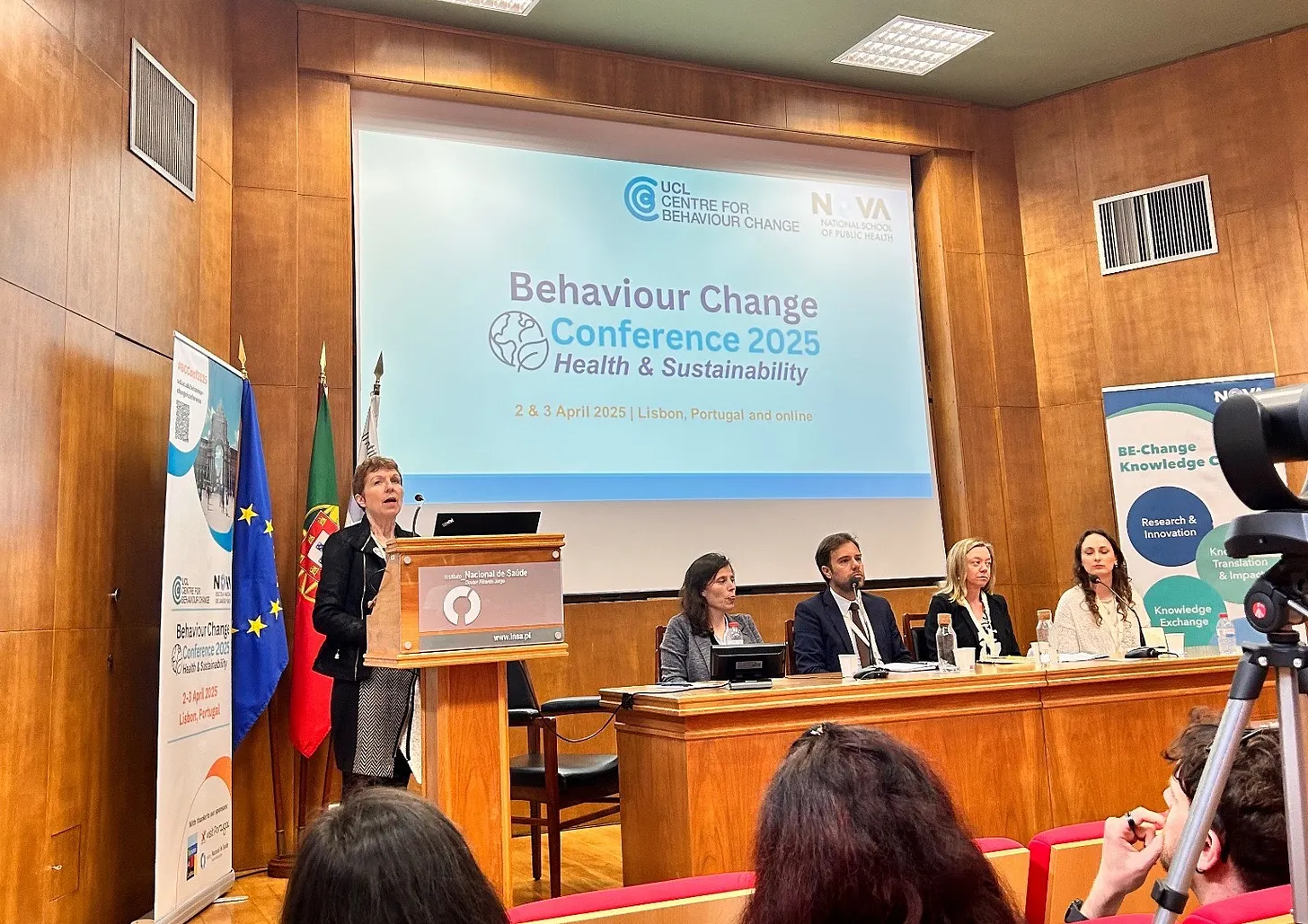
The Institute's team also had the opportunity to take part in a conference organized by the UCL group in Lisbon last April. There, Flora Pfeifer, Caroline Reis, and Claudio Meilman, founders and directors of the IBCC, presented their work on habit consultation and its applications in weight-loss contexts, exchanging experiences with peers in the field.
What is an ontology?
Drawing on the contemporary definition from information science, an ontology is a structured way of organizing knowledge, defining entities and, above all, the relationships between them. These are divided into classes based on their characteristics, and each category gets its own identifier. That way, both people and computers can use it to organize knowledge and reach a shared point of understanding. There's even a repository of ontologies for the humanities and social sciences.
For the BCIO, this means moving away from a field where concepts often overlap or are used inconsistently, toward something structured. Having a comprehensive ontology of behavior change knowledge allows for the standardization of evidence in behavioral science and opens the door to rigorous integration at greater scale, through machine learning and artificial intelligence — ongoing initiatives from the research group.
COM-B and BCTs: from diagnosis to intervention
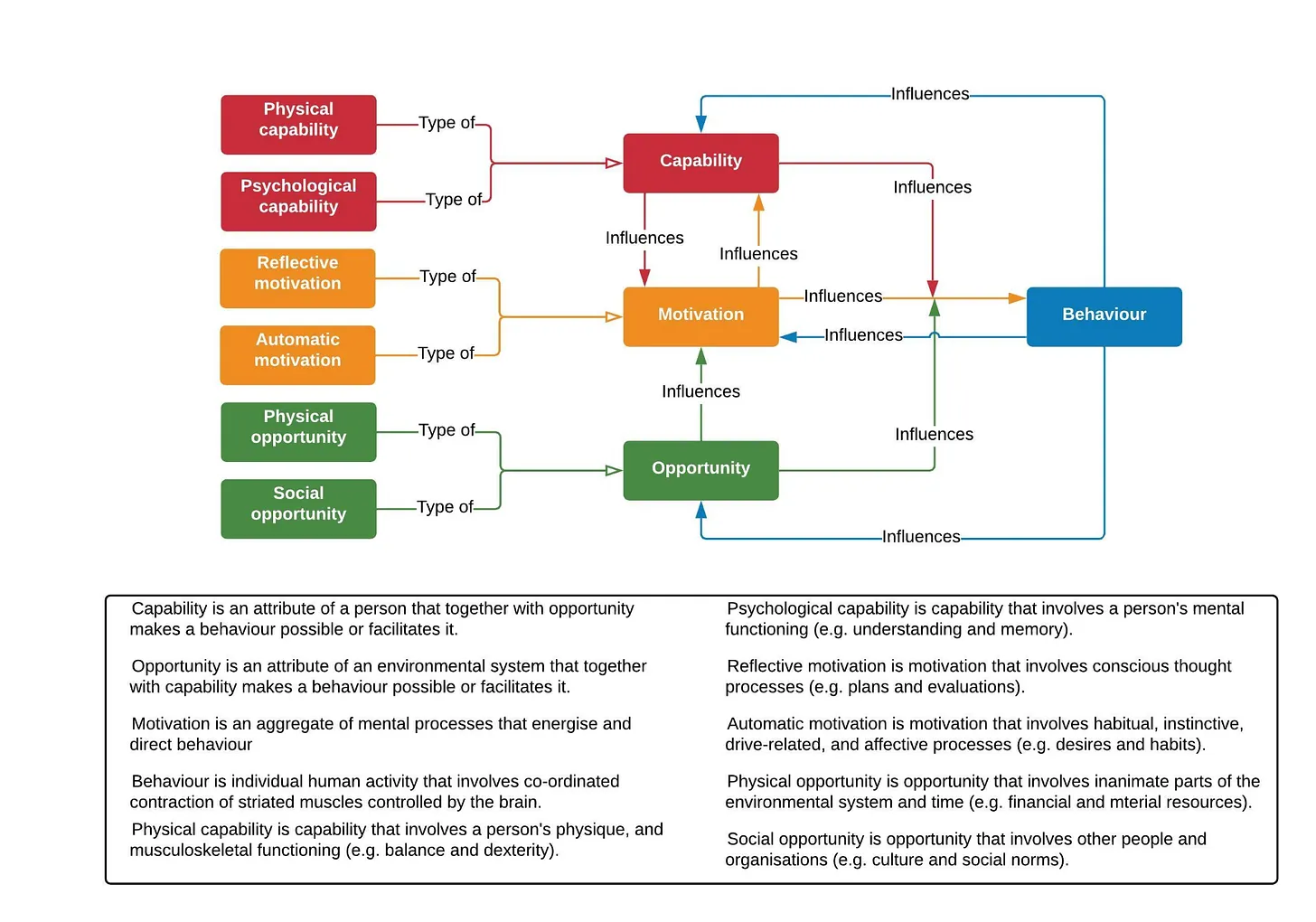
This whole effort began in 2011, when UCL researchers proposed the COM-B model. The framework emerged as a kind of organizing axis for behavior change, at a time when the field was starting to spread into market practice and the public sector, and tools, frameworks, and models were proliferating haphazardly, mixing different classes of elements into the same category with no rigor at all. COM-B starts from a simple but powerful idea: behavior is a function of three elements — Capability, Opportunity, and Motivation (Michie et al., 2011).
- Capability: what can the individual do?
- Opportunity: what does the context allow to happen?
- Motivation: what drives (or doesn't drive) the individual toward that behavior?
Each of these elements can be broken down further, spanning different types of processes, as shown in the figure below. When an individual has the motivation, capability, and opportunity to perform a behavior, it happens. Motivation influences capability; opportunity and capability influence motivation; and the occurrence of the behavior in turn influences capability, opportunity, and motivation.
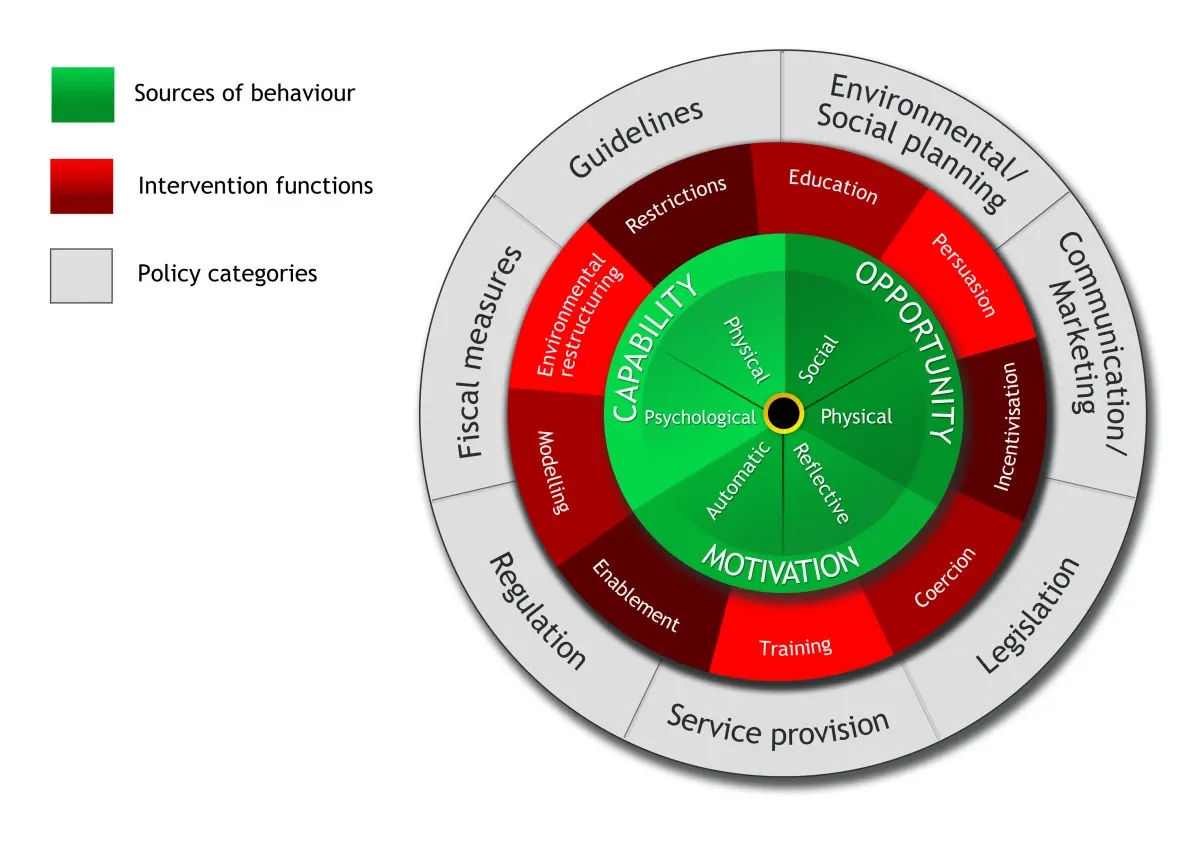
The model helps us better understand why a behavior occurs (or doesn't), predict whether it will occur, and design interventions aimed at changing it. For that last purpose, researchers formulated the Behaviour Change Wheel, with COM-B at its center. It connects each explanatory component of behavior to an intervention function, and in turn, to a category of public policy.
The Theoretical Domains Framework (TDF) was created to "simplify and integrate a vast range of behavior change theories, making them more accessible and usable by other disciplines" (Cane et al., 2012). In a 2012 paper, continuing on from the COM-B work of the previous year and an initial effort to systematize the TDFs in 2005, the group — which included health psychologists, health workers, and theoretical psychologists — identified 33 theories and 128 theoretical constructs related to behavior change, and synthesized them into a single framework. Through a validation process, they arrived at fourteen domains, with 84 associated constructs: "Knowledge," "Skills," "Social/Professional Role and Identity," "Beliefs about Capabilities," "Optimism," "Beliefs about Consequences," "Reinforcement," "Intentions," "Goals," "Memory, Attention, and Decision Processes," "Environmental Context and Resources," "Social Influences," "Emotion," and "Behavioural Regulation." Rather than working with broad categories, the TDF "opens the box" on COM-B. In practice, it works like a magnifying glass, surfacing variables that would go unnoticed in a more superficial analysis.
Finally, Behaviour Change Techniques (BCTs) are the operational level — the smallest components that can actually be implemented. They're the "active ingredients" of behavioral interventions, the "irreducible" building blocks of what an intervention consists of. If COM-B helps us understand why a behavior happens (or doesn't), BCTs help define what to do about it — the "how" of change. The first effort, from 2013, gathered 93 techniques into 26 categories (BCTTv1) (Michie et al., 2013).
Updates to the BCIO and COM-B
The BCIO's most recent proposal goes beyond interventions and causes, seeking to organize different types of elements according to the "BCIO triangle." It's worth noting that, beyond the components that characterize the intervention itself, aspects of the context and of engagement with the intervention also matter for the outcome (whether the behavior occurs).
The revision of COM-B, expected earlier this year, offers three main changes: it separates an individual-level model from a population-level one; it defines its components more precisely within the BCIO; and it brings more granularity to the model's components, breaking them into smaller parts for a more precise diagnosis, as discussed in the authors' presentation.
The population-level model recognizes that a population can be better described by its statistical distribution, turning a given group's COM-B components into variables (or functions built on them) that can be estimated through regression. The effort adds a quantitative dimension to a framework that, until now, was used mostly in theoretical and qualitative ways.
Similarly, BCTs have also gone through a revision, forming the Behaviour Change Technique Ontology (BCTO). In the process, some techniques were split apart, and definitions and categories were refined. The latest version includes 259 techniques, divided into 20 categories (Marques et al., 2023). The repository can be accessed here.
These updates add to the repertoire of behavioral science and behavior change, providing the tools for the field to advance as a science: rigor, standardization, and a common language among its practitioners.
References
Cordioli, A. V., & Grevet, E. H. Psicoterapias: Abordagens Atuais. Artmed Editora, 2018.
Michie, S., van Stralen, M. M., & West, R. (2011). The behaviour change wheel: A new method for characterising and designing behaviour change interventions. Implementation Science, 6, 42.
Cane, J., O’Connor, D., & Michie, S. (2012). Validation of the theoretical domains framework for use in behaviour change and implementation research. Implementation Science, 7, 37.
Michie, S., Richardson, M., Johnston, M., Abraham, C., Francis, J., Hardeman, W., Eccles, M. P., Cane, J., & Wood, C. E. (2013). The behavior change technique taxonomy (v1) of 93 hierarchically clustered techniques. Annals of Behavioral Medicine, 46(1), 81–95.
Marques, M. M., Wright, A. J., Johnston, M., West, R., Hastings, J., Zhang, L., & Michie, S. (2023). The Behaviour Change Technique Ontology: Transforming the Behaviour Change Technique Taxonomy v1.
Enjoyed this? Subscribe to Café Comportamental for weekly essays in Portuguese, or explore more in Resources.